Kraków: Royal City & Salt Mine
Gothic spires, cellar bars, and a thousand years of Polish history — a walkable royal capital where Kazimierz lanes and Wawel stone share the same evening light
- Duration
- 5 Days / 4 Nights
- Destinations
- Kraków · Wieliczka · Kazimierz
- Best season
- May – September
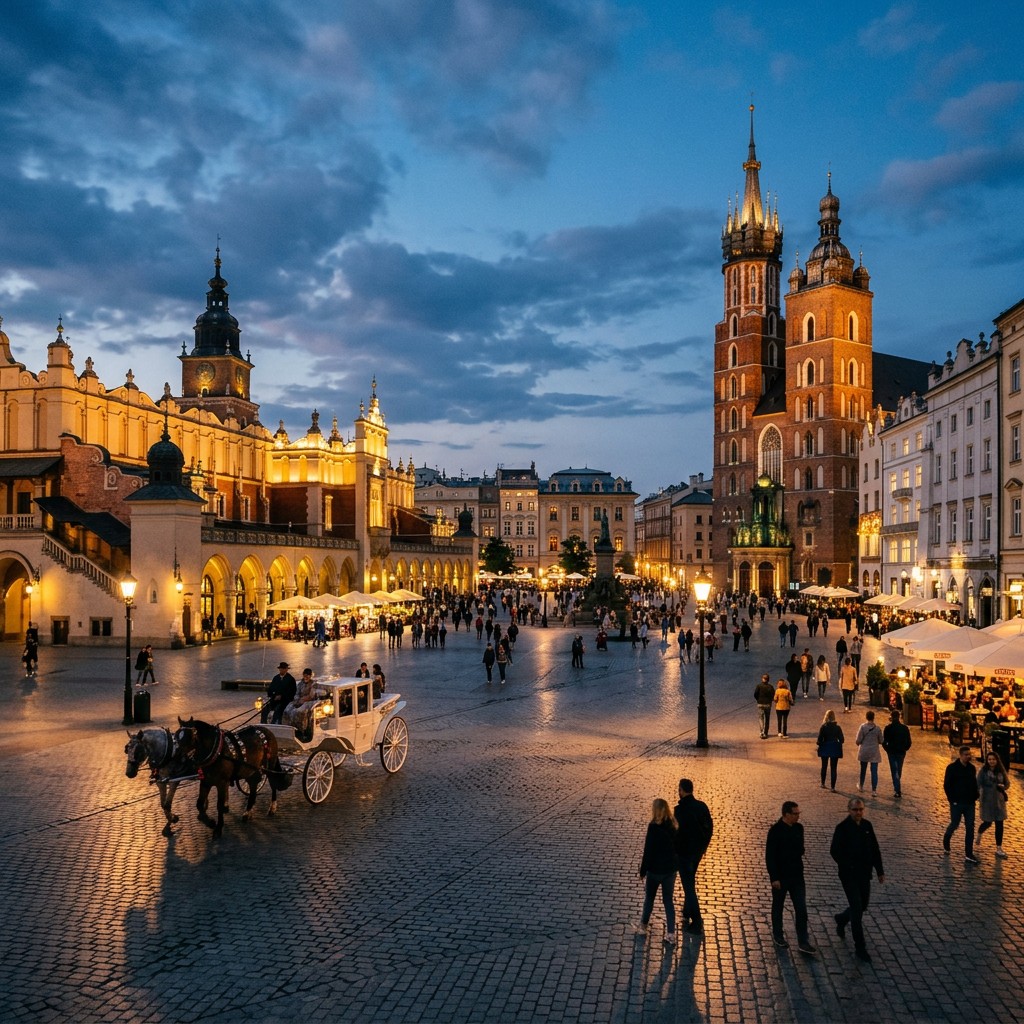
Kraków survived the Second World War intact — one of the few major European cities that did — and the result is a medieval and Renaissance core so complete it feels like walking through a history textbook that someone forgot to close. The Rynek Główny (Main Market Square) is Europe's largest medieval square. The Kazimierz district pulses with a creative energy that honors its Jewish heritage while building something entirely new. And the food — from pierogi to żurek to smoked cheese — is vastly underrated. This journey takes all of it at walking pace.
Day 1
Arrival in Kraków
Private transfer from John Paul II Airport to Hotel Copernicus, a 15th-century Renaissance townhouse on Kanonicza Street at the foot of Wawel Hill — original frescoed ceilings, a rooftop pool with castle views, and an intimacy that the larger hotels can't match. Settle in with a glass of Polish mead in the vaulted stone lounge. Evening: a welcome dinner at Szara Gęś (The Grey Goose), one of the grand restaurants on the Main Market Square — duck confit with plum sauce, pierogi with wild mushrooms, and a glass of Silesian Riesling from Poland's quietly improving wine scene.
- Stay: Hotel Copernicus — Suite with Wawel Castle views, rooftop pool
- Culinary: Welcome dinner at Szara Gęś
Day 2
Old Town: Wawel, the Square & Cloth Hall
Your private guide leads a morning exploration of Wawel Royal Castle — the State Rooms (Renaissance tapestries, Italian courtyard), the Cathedral (coronation church of Polish kings, with Sigismund's Bell in the tower), and the Dragon's Den beneath the hill. Descend to the Rynek Główny: the Cloth Hall's upstairs gallery of 19th-century Polish painting, St. Mary's Basilica (where the wooden altarpiece by Veit Stoss is among the greatest Gothic sculptures in Europe), and the underground Rynek Museum beneath the square — a multimedia excavation of the medieval city. Lunch: a milk bar (bar mleczny) for the authentic Polish canteen experience — pierogi ruskie, barszcz (beetroot soup), and naleśniki (crepes with sweet cheese). Afternoon at leisure to explore the Planty park ring or browse the Floriańska Street galleries. Evening: cocktails at Szara Cocktail Bar on the square, then dinner at Bottiglieria 1881, a Michelin-recommended restaurant in a 19th-century pharmacy serving contemporary Polish cuisine.
- Cultural: Wawel Castle, St. Mary's Basilica, and Rynek Underground Museum
- Culinary: Milk bar lunch (pierogi, barszcz), dinner at Bottiglieria 1881
Day 3
Kazimierz & Jewish Heritage
Walk south into Kazimierz, Kraków's historic Jewish quarter — your guide provides the deep context of 700 years of Jewish life, the devastation of the Holocaust, and the district's contemporary resurrection as a creative hub. Visit the Old Synagogue (Poland's oldest), the Remuh Synagogue and its Renaissance cemetery, and the Galicia Jewish Museum for its photographic record of Jewish traces across southern Poland. Cross the river to Podgórze for the Schindler Factory Museum, now a superb multimedia exhibition on Kraków under Nazi occupation. Lunch at Starka, a Kazimierz restaurant specializing in traditional Polish cuisine and house-infused vodkas — the żurek (sour rye soup served in a bread bowl) is outstanding. Afternoon: explore Kazimierz's independent bookshops, vintage stores, and craft coffee roasters. Evening: live klezmer music at one of the district's atmospheric venues.
- Cultural: Kazimierz Jewish heritage walk with historian guide, Schindler Factory
- Culinary: Żurek and flavored vodkas at Starka
- Music: Live klezmer evening
Day 4
Wieliczka Salt Mine & Farewell
Morning drive to Wieliczka Salt Mine (20 minutes), a UNESCO World Heritage Site 327 meters deep. Your guide leads you through carved chambers, underground lakes, and the extraordinary Chapel of St. Kinga — an entire cathedral-sized church carved from salt by miners over decades, including chandeliers, altarpieces, and floor tiles, all salt. Return to Kraków for a free afternoon — your Byline companion can arrange a Polish cooking class (hand-pleat pierogi, make bigos hunter's stew), a street-art walking tour of Podgórze, or a visit to the MOCAK Museum of Contemporary Art. Farewell dinner at Pod Baranem, a Kraków institution in a 14th-century cellar — roast duck with apples, silesian dumplings, and a bottle of Polish craft beer.
- Cultural: Wieliczka Salt Mine with Chapel of St. Kinga
- Culinary: Farewell dinner at Pod Baranem (medieval cellar)
Day 5
Departure
Private transfer to Kraków Airport. Your Byline concierge confirms flight details. If your flight is late, a morning walk to the Podgórze flea market or a final coffee on the Rynek is time well spent.
All accommodation at Hotel Copernicus (suite with Wawel views). Private airport transfers. Local historian guide for all scheduled touring days. Daily breakfast at hotel. Szara Gęś welcome dinner, milk bar lunch, Starka lunch, Bottiglieria 1881 dinner, and Pod Baranem farewell dinner. Wawel Castle State Rooms and Cathedral, St. Mary's Basilica, Rynek Underground Museum, Kazimierz Jewish heritage walk, Schindler Factory, and Wieliczka Salt Mine. Byline trip companion and 24/7 remote support throughout.
Every Byline journey is built to order — swap a hotel, add a day, tune the rhythm.
Customize This Journey