Galápagos Islands: Evolution's Laboratory
Giant tortoises, marine iguanas, and blue-footed boobies that have never learned to fear humans — the archipelago that changed how we understand life on earth
- Duration
- 8 Days / 7 Nights
- Destinations
- Quito · Santa Cruz · Isabela · Fernandina
- Best season
- June – November (dry, cooler) / December – May (warm, calmer seas)
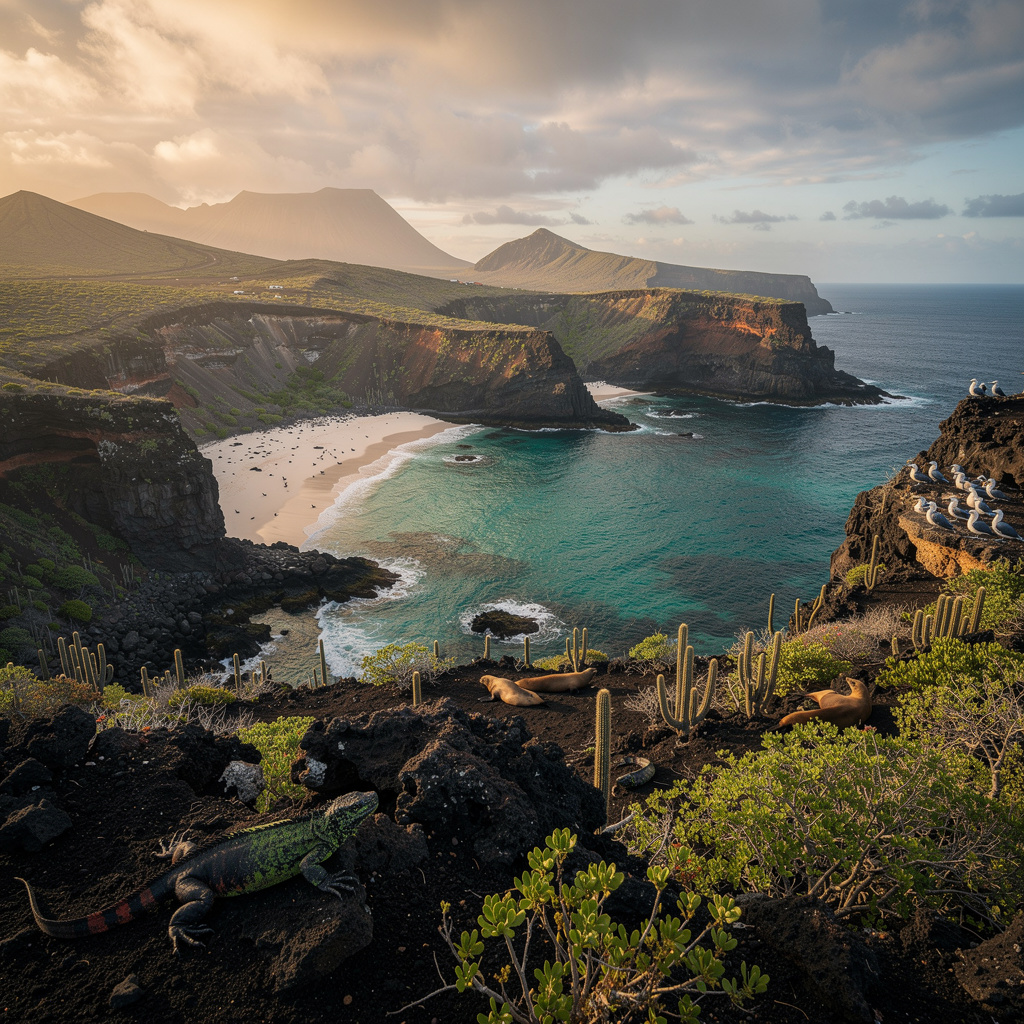
The Galápagos are the only place on earth where wildlife has no instinct to flee from humans — because for most of evolutionary history, humans weren't there. Sea lions sleep on park benches, marine iguanas sneeze salt at your feet, and giant tortoises cross hiking trails at a pace that suggests they've been doing this since before Darwin arrived. This journey pairs a short Quito introduction with a small-ship expedition cruise through the archipelago — the format that maximizes island access and naturalist-guided encounters while minimizing the footprint the park strictly regulates.
Day 1
Arrival in Quito
Fly into Mariscal Sucre Airport. Private transfer to Casa Gangotena, a restored belle-époque mansion on Plaza San Francisco in Quito's colonial center — the rooftop terrace overlooks the basilica and the Andean volcanoes beyond. Evening: welcome dinner at the hotel's restaurant — Ecuadorian locro de papas (potato and cheese soup), llapingachos (potato cakes), and a glass of high-altitude Ecuadorian wine.
- Stay: Casa Gangotena — Plaza-view suite, Quito
- Culinary: Ecuadorian welcome dinner
Day 2
Quito: Colonial City & Equator
Morning guided walk through Quito's UNESCO-listed colonial center — the Compañía de Jesús church (the most ornate Baroque interior in South America, covered in gold leaf), Plaza de la Independencia, and the San Francisco Monastery. Drive 20 minutes north to the Mitad del Mundo (Middle of the World) monument and the Intiñan Museum, where you straddle the equator line and see demonstrations of Coriolis effects. Lunch at Zazu, one of Quito's best contemporary restaurants — Chef Alexander Lauaert's menu bridges Ecuadorian ingredients and European technique. Afternoon flight to Galápagos (approximately 2.5 hours to Baltra).
- Cultural: Quito colonial center, Compañía de Jesús, equator
- Culinary: Lunch at Zazu
Day 3
Santa Cruz: Giant Tortoises & Research Station
Board your expedition vessel. Morning visit to the Charles Darwin Research Station on Santa Cruz, where the giant tortoise breeding program has brought several subspecies back from the brink of extinction — see hatchlings, juveniles, and the enormous adults in their pens. Afternoon: the Santa Cruz highlands, where giant tortoises roam wild in the misty grasslands — these are the animals Darwin observed, and they still move with the same prehistoric calm. Lava tunnels in the highlands. Return to the ship for a naturalist briefing and dinner aboard.
- Cultural: Charles Darwin Research Station
- Wildlife: Wild giant tortoises in the highlands
Day 4
North Seymour & Bartolomé
Morning wet landing on North Seymour Island — a flat, arid island where blue-footed boobies perform their mating dance (a high-stepping lift of their blue feet), magnificent frigatebirds inflate their red throat pouches, and sea lions body-surf the shore break. Your naturalist guide explains the evolutionary pressures that shaped each behavior. Afternoon: Bartolomé Island — climb 114 wooden steps to the summit for the iconic Pinnacle Rock view (the most photographed landscape in the Galápagos), then snorkel with Galápagos penguins, white-tipped reef sharks, and sea turtles in the crystal-clear bay.
- Wildlife: Blue-footed boobies, frigatebirds, sea lions on North Seymour
- Scenic: Pinnacle Rock viewpoint, Bartolomé
- Snorkeling: Galápagos penguins and reef sharks
Day 5
Isabela: Volcanoes & Flamingos
Sail to Isabela, the largest island in the archipelago. Morning: hike the Sierra Negra volcano rim trail — the second-largest volcanic caldera on earth, with views across a landscape that looks like another planet. Afternoon: Flamingo Lagoon (Poza de los Flamingos), where American flamingos feed in the brackish water. Snorkeling at Los Túneles, a series of lava archways and tunnels above and below the waterline — sea horses, manta rays, and sea turtles in the shallows.
- Scenic: Sierra Negra volcano caldera hike
- Wildlife: Flamingos, sea horses, manta rays at Los Túneles
Day 6
Fernandina & Tagus Cove
Fernandina is the youngest and most volcanically active island — and the most pristine, with no introduced species. Morning: Punta Espinoza, where the world's only marine iguanas (found nowhere else on earth) pile on the black lava in their hundreds, warming in the equatorial sun before diving into the cold Cromwell Current to feed on underwater algae. Flightless cormorants dry their vestigial wings on the rocks — the only cormorant species that cannot fly, its wings having evolved smaller over millennia of island isolation. Afternoon: panga (dinghy) ride along the cliffs of Tagus Cove, looking for Galápagos penguins, sea lions, and brown pelicans. Snorkeling in the cove with marine turtles.
- Wildlife: Marine iguanas, flightless cormorants, Galápagos penguins on Fernandina
Day 7
Española: Albatross & Blowhole
Sail south to Española, the oldest island. Morning at Punta Suárez — waved albatrosses (April–December only, the world's entire population nests here), Nazca boobies, and the dramatic blowhole where ocean surges eject 25-meter plumes through the lava shelf. The "albatross runway" — a cliff edge where the birds take off by running to the edge and launching into the wind — is one of the Galápagos' most spectacular sights. Afternoon: Gardner Bay, a pristine white-sand beach where sea lions lounge and Española mockingbirds (fearless and curious) hop directly up to examine you.
- Wildlife: Waved albatross colony, Nazca boobies, sea lions on Española
Day 8
Return & Departure
Morning at leisure aboard or a final snorkel. Disembark at Baltra and fly to Quito or Guayaquil for your international connection. Your Byline concierge confirms all logistics.
All accommodation (Casa Gangotena Quito, expedition cruise vessel for 5 nights). International flight Quito–Galápagos–return. Private Quito transfers and guides. Galápagos National Park entry fee and transit control card. All meals aboard expedition vessel. All guided island visits, snorkeling equipment, and zodiac/panga excursions. Certified naturalist guides throughout the cruise. Casa Gangotena welcome dinner and Zazu lunch. Byline trip companion and 24/7 remote support throughout.
Every Byline journey is built to order — swap a hotel, add a day, tune the rhythm.
Customize This Journey